
























































































































































Active Information Gathering
DNS Enumeration
host
host to find A record
host www.megacorpone.com
host to find mx or txt records
host -t mx megacorpone.com
host -t txt megacorpone.com
Bash one-liner to resolve list of hostnames
for ip in $(cat list.txt); do host $ip.megacorpone.com; done
for ip in $(cat list.txt); do host $ip.megacorpone.com; done | grep -v "not found"
DNSRecon
dnsrecon -d megacorpone.com -t std
Bruteforce list of subdomain strings
dnsrecon -d megacorpone.com -D ~/list.txt -t brt
DNSEnum
dnsenum megacorpone.com
Enumerate with Gobuster
gobuster dns -d example.com -w /usr/share/seclists/Discovery/DNS/subdomains-top1million-110000.txt -t 50
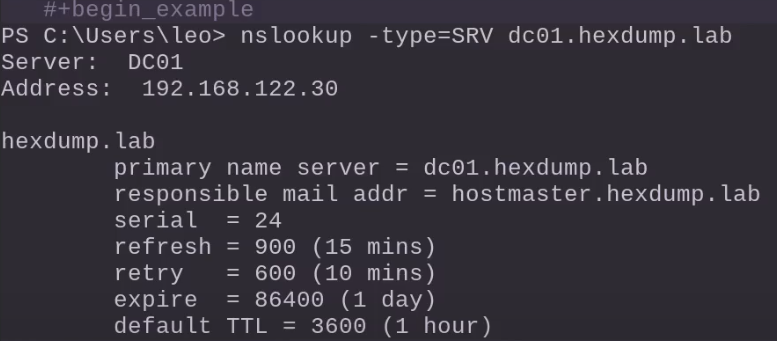
nslookup
A Record enumeration
nslookup mail.megacorptwo.com
TXT Record enumeration
nslookup -type=TXT info.megacorptwo.com 192.168.50.151
TCP/UDP Port Scanning Theory
netcat
Scan specific ports
nc -nvv -w 1 -z 192.168.50.152 3388-3390
Scan specific UDP ports
nc -nv -u -z -w 1 192.168.50.149 120-123
nmap Port Scanning
SYN stealth scan
sudo nmap -sS IP
TCP scan
nmap -sT IP
UDP scan
sudo nmap -sU -sS IP
sudo nmap -F -sU -sV $IP
Aggressive scan
nmap -T4 -p- -A 192.168.5.0/24
Disable ping command and use a min rate
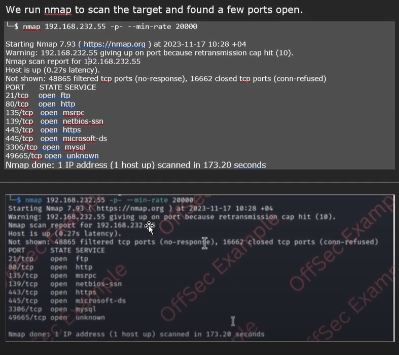
nmap -p- --min-rate 1000 $IP -Pn
Save output to greppable parameter
nmap -V -sn 192.168.50.1-253 -oG ping-sweep.txt
Check top ports (aggressive scan)
nmap -sT -A --top-ports=20 192.168.50.1-253 -oG top-port-sweep.txt
Check for OS scan specificallly
sudo nmap -O IP --osscan-guess
nmap -p <ports> -sV -sC -A $IP
Inspect service banners (aggressive)
nmap -sT -A IP
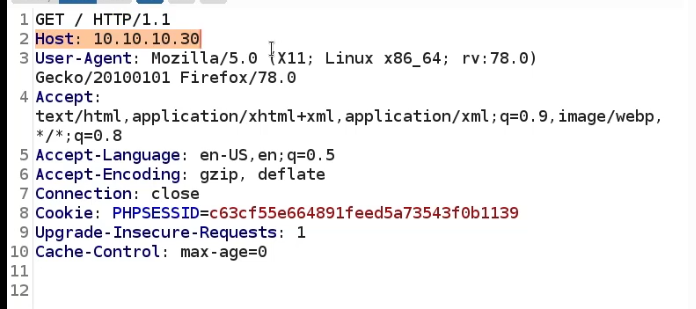
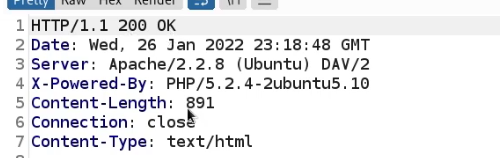
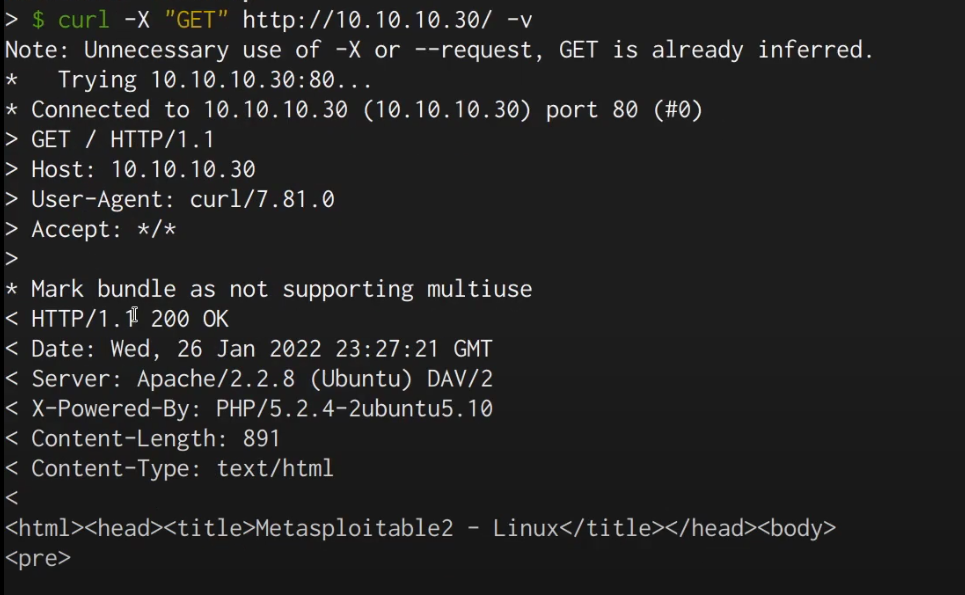
nmap --script http-headers IP
Stealth scan
nmap -sS -p- --min-rate=1000 10.11.1.229 -Pn #stealth scans
Use rustscan in conjuncture with nmap
rustscan -a <target> -p 3000,3001,3002,3003 -- -sV
Autorecon
autorecon 192.168.238.156 --nmap-append="--min-rate=2500" --exclude-tags="top-100-udp-ports" --dirbuster.threads=30 -vv
Script to automate network enumeration
#!/bin/bash

target="$1"
ports=$(nmap -p- --min-rate 1000 "$target" | grep "^ *[0-9]" | grep "open" | cut -d '/' -f 1 | tr '\n' ',' | sed 's/,$//')

echo "Running second nmap scan with open ports: $ports"

nmap -p "$ports" -sC -sV -A "$target"
Scanning with Windows
Port scan from Windows with Powershell (single port)
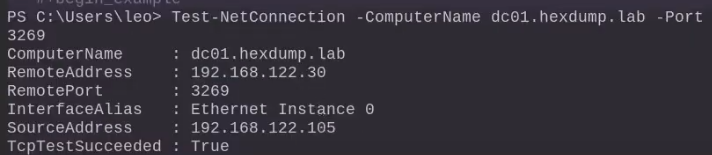
Test-NetConnection -Port PORT IP
Automate port scanning with Powershell (first 1024 ports)
1..1024 | % {echo ((New-Object Net.Sockets.TcpClient).Connect("192.168.1.151", $_)) "TCP port $_ is open"} 2>$null
SMB Enumeration
nmap scan
nmap -v -p 139,445 -oG smb.txt 192.168.50.1-254
Check for NetBIOS information
sudo nbtscan -r 192.168.50.0/24
SMB OS discovery
nmap -v -p 139,445 --script smb-os-discovery 192.168.50.152
Enumerate SMB from Windows with net view
net view \\dc01 /all
SMTP Enumeration
Looking for VRFY & EXPN requests among others
nc -nv 192.168.50.8 25
Python script opening a TCP socket, connecting to the SMTP server and issuing a VRFY command for a give username
#!/usr/bin/python

import socket
import sys

if len(sys.argv) != 3:
        print("Usage: vrfy.py <username> <ip>")
        sys.exit(0)

#Create a socket
s = socket.socket(socket.AF_INET, socket.SOCK_STREAM)

#Connect to the server
ip = sys.argv[2]
connect = s.connect((ip,25))

#Receive the banner
banner = s.recv(1024)

print(banner)

#VRFY a user
user = (sys.argv[1]).encode()
s.send(b'VRFY ' = user + b'\r\n')
result = s.recv(1024)

print(result)

#Close socket
s.close()
python3 smtp.py user ip
Windows Scanning SMTP
Enumerate SMTP information from Windows
Test-NetConnection -Port IP
Enumerate SMTP fully using telnet (may be unavailable or the binary may need to be transferred in)
dism /online /Enable-Feature /FeatureName:TelnetClient
Management Information Base (MIB) strings (Windows)
| 1.3.6.1.2.1.25.1.6.0 | System Processes |
|---|---|
| 1.3.6.1.2.1.25.4.2.1.2 | Running Programs |
| 1.3.6.1.2.1.25.4.2.1.4 | Processes Path |
| 1.3.6.1.2.1.25.2.3.1.4 | Storage Units |
| 1.3.6.1.2.1.25.6.3.1.2 | Software Name |
| 1.3.6.1.4.1.77.1.2.25 | User Accounts |
| 1.3.6.1.2.1.6.13.1.3 | TCP Local Ports |
SNMP Enumeration
nmap scanning for SNMP
sudo nmap -sU --open -p 161 192.168.50.1-254 -oG open-snmp.txt
onesixtyone (bruteforce against community strings and IP addresses)
onesixtyone -c commuity -i ips
snmpwalk
Tool that parses a specific branch of the MIB tree called OID, giving it a string returns machine information
We will need the SNMP read-only community string to use this (its usually set to public)
snmpwalk -c public -v1 -t 10 IP
snmpwalk -c public -v1 IP 1.3.6.1.2.1.35.4.2.1.2
Query all software installed on the machine
snmpwalk -c public -v1 IP 1.3.6.1.2.1.25.6.3.1.2
List all current TCP listening ports
snmpwalk -c public -v1 IP 1.3.6.1.2.1.6.13.1.3